“Luxury” is the most abused word in Marbella property marketing. Every listing claims...Read More
Living in Marbella, and specifically on the Golden Mile, has a rhythm you cannot get from a property brochure. The morning paddle along the Paseo Marítimo with Puente Romano in the background. The school run to Aloha College or Swans International. The long weekend lunches at Sea Grill. The November-to-February quiet that almost nobody who has not lived through it can imagine. This is an editorial walk through a typical year of living on the Marbella Golden Mile in 2026. We cover daily life, the seasonal rhythm, the venues residents use, and the practical realities of the commute and the school run. The article ends with how the area changes between peak summer and deep winter.
Two numbers define the Marbella property market in 2026, and they are not the same.
The first is the average asking price, which sits at €6,075 per square metre as of January 2026, a 5.38% increase year on year. This is what sellers are listing properties at, and it is the figure most quoted in market commentary.
The second is the average verified sale price, which Tinsa records at €3,421 per square metre. This is what buyers are actually completing on after negotiation. The gap between the two is normal in any prime market: asking prices reflect aspiration and starting position, sale prices reflect closed transactions. Both numbers matter when calibrating a budget.
To put Marbella in context, the city sits 29% above the Málaga provincial average and 36% above the wider regional benchmark, which is why it consistently ranks among the most premium property markets in Spain. Across 2025, Marbella posted a 5.57% average price increase, and growth is forecast at 3.5% to 8% annually through 2026, supported by constrained supply and sustained international demand.
For context on the wider market, INE (Instituto Nacional de Estadística) publishes the official Spanish property transaction data and price indices used by professionals across the industry.
The Marbella Golden Mile is not a uniform experience across the year. Living in Marbella, and particularly in this area, means adapting to four distinct seasonal patterns rather than living through one continuous Mediterranean summer.
Spring is when the area comes back to life after the winter quiet. Sea temperatures begin climbing in late April. The beach clubs reopen in stages from Easter onwards (Ocean Club, the Beach Club at Marbella Club, the Puente Romano beachfront restaurants). Restaurant terraces fill out from April. Tennis courts at the Puente Romano start hosting their season-opening events. Pavement cafés along Avenida Príncipe Alfonso von Hohenlohe (the N-340 main road) shift their seating outside.
April is, for many full-year residents, the favourite month. The weather is reliably warm (averaging 18–22°C during the day) but the area is still calm. You can get a Saturday lunch booking at Nobu with three days’ notice. The Paseo Marítimo is busy enough to feel alive but not crowded. Tennis tournaments at the Puente Romano start drawing visiting players.
By May, the rhythm has shifted noticeably. Pool maintenance has finished across the apartment complexes. Beach club table prices start climbing. The summer school holiday inflows from Northern Europe begin in the last week.
This is the Marbella Golden Mile at full intensity. The area transforms.
Restaurants run at capacity from 8pm to midnight, with bookings required for any of the Puente Romano cluster, the Marbella Club restaurants, and the beachfront venues. Beach club tables at Nikki Beach, Ocean Club, and the Trocadero Arena require advance reservation, particularly at weekends. The Paseo Marítimo bicycle and pedestrian traffic peaks between 10am and 1pm and again between 6pm and 9pm.
Living in Marbella through summer means adapting your rhythm. Many full-year residents shift earlier: morning beach walks at 7–8am before the heat, indoor work or shade from 12–4pm, social and dining activity from 6pm onwards. Sea temperatures peak in August at 24–26°C, warmer than the early summer.
The school year ends in mid-June. Aloha College and Swans International both run summer camps that absorb a portion of the younger family demographic. The remaining families travel, host visiting relatives, or settle into a different daily rhythm.
The intensity peaks across the Salduba Cup polo tournament (early August), the Starlite Festival (June to September at the Cantera de Nagüeles amphitheatre, a 15-minute drive from most Golden Mile addresses), and the Marbella tennis exhibitions at Puente Romano.
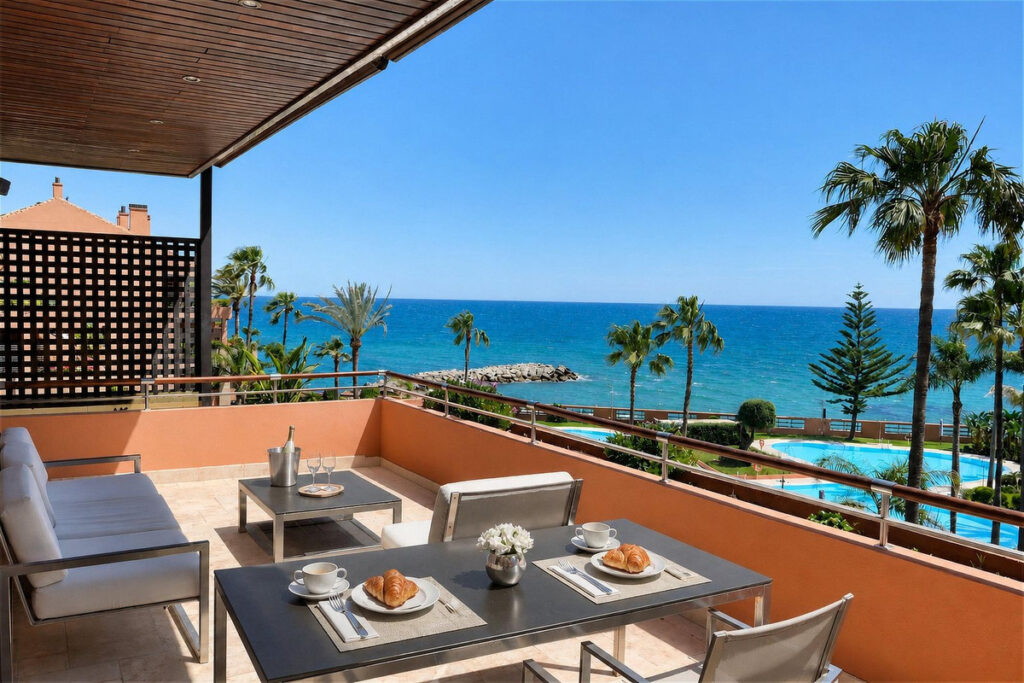
October is the second beautiful shoulder month, mirroring April but warmer and quieter as the summer crowd departs. Sea temperatures hold above 22°C through October and most of the dining and beach club venues remain open. By the second week of October, restaurant bookings ease. By mid-November, half the beach clubs close for the winter.
The school year is in full swing. Aloha College, Swans International, EIC, and the other international schools settle into their term rhythm. The commercial centres of Marbella town and Nueva Andalucía see a noticeable bump in mid-morning trade as the post-drop-off coffee culture takes hold.
Living in Marbella through winter is the part of the year that most online lifestyle content underplays. The area is genuinely quieter, with temperatures averaging 12–18°C during the day and 8–12°C at night. Some restaurants close for January. Many beach clubs reopen only at Easter. The Paseo Marítimo is calm enough that you may walk a kilometre without crowding.
For families, schools and commercial life continue uninterrupted. For lifestyle buyers, winter is the period when the difference between full-year residence and seasonal use becomes most visible. Full-year residents establish indoor rhythms (the Puente Romano spa, indoor tennis at the Puente Romano, hiking the trails up La Concha mountain, day trips to Ronda or Granada). Seasonal owners typically travel home during this window.
The compensating beauty of winter is that the Marbella Golden Mile is at its quietest. The dining venues that stay open run with locals and full-year residents. The hike up La Concha (a half-day climb from a trailhead 15 minutes from most Golden Mile addresses) is best done in January and February when the heat is manageable.
The texture of daily life depends on whether you are a working full-year resident, a family with school-age children, or a retired or semi-retired lifestyle buyer.
Many full-year residents now work remotely or run businesses that allow flexible schedules. The day might start with a 7am walk along the Paseo Marítimo from Puente Romano toward central Marbella (a 30-minute round trip), followed by remote work from home or from one of the area’s co-working spaces (Epic Marbella in the Puente Romano cluster is the most established). Lunch at home or at a café along the Avenida Príncipe Alfonso von Hohenlohe. Afternoon meetings remote. Padel or tennis at 6pm. Dinner at 9pm, either at home or at one of the cluster restaurants.
Aloha College drop-off is from 8.10am. Swans International primary campus at El Capricho is a similar timing. The school run is the single most concentrated daily commute, with traffic on the N-340 and the Marbella access roads measurably heavier between 7.45am and 9am. After-school activities run from 4pm, with sports clubs, swimming, padel, and tennis spread across multiple venues. Family dinners are typically earlier (7pm) than the lifestyle rhythm. Weekends balance beach and pool time with cultural day trips (Ronda, Granada, the Caminito del Rey hike).
A more flexible day. Morning beach walk or pool. Coffee on the terrace. Late breakfast or brunch at one of the cluster cafés. Tennis, golf at one of the nearby courses (La Quinta, Los Naranjos, Aloha, all 15 minutes by car), or shopping in Marbella town or Puerto Banús. Long lunch with friends at the Marbella Club, Sea Grill, or one of the Puente Romano restaurants. Afternoon rest or reading. Early evening drink at La Plaza in Puente Romano. Dinner.
Marbella does not have a metro system or major commuter rail. Daily commuting between Golden Mile addresses and the main work locations (central Marbella town centre, Puerto Banús, Estepona) is by car or bicycle, with some bus routes serving the major hubs.
Travel times from a typical Golden Mile address:
Peak traffic is the morning school run (7.45–9am) and the Friday-evening Málaga-Marbella inbound traffic. Outside those windows, the area moves quickly.
A short list of the venues that show up in most full-year residents’ weekly rhythms.
Marbella Club Hotel. El Grill restaurant for traditional Andalusian cuisine. The Beach Club for summer lunches. The gardens and grounds open to guests of the hotel and restaurant clients.
Puente Romano Resort. Nobu, Cipriani, Sea Grill, Gaia, Leña, the Six Senses Spa, the tennis club, the beach. The cluster is large enough to absorb most of a week’s dining and amenity needs.
Ocean Club Marbella. The summer beach club anchor. Reservation-only on summer Saturdays.
Trocadero Arena. Quieter beach club option toward Marbella East, popular with families.
Marbella Old Town. Plaza de los Naranjos and the surrounding tapas streets, 10 minutes by car from most Golden Mile addresses. Genuine Spanish dining without the resort prices.
Mercacentro and El Corte Inglés in Puerto Banús. Practical shopping for daily life.
Hospital Quirónsalud Marbella. The main private hospital, 10 minutes by car from most Golden Mile addresses.
Aloha Pelayo Padel Club. Padel courts widely used by the Golden Mile resident community.
Three honest observations from the residents we work with regularly.
The pace is slower than most people expect. Marbella is a town, not a city. The amenity density is real, but the working-day pace is Mediterranean: shops close at 2pm in winter, restaurants do not get busy until 9pm, traffic moves at a relaxed speed. Buyers coming from London, New York, or Hong Kong sometimes find this an adjustment.
The international community is the social anchor. UK, Scandinavian, German, Dutch, and increasingly American residents form an extensive network that operates partly through schools (Aloha, Swans), partly through clubs (tennis, padel, golf), and partly through the dining-and-beach-club rhythm. New residents who plug into one of these usually find the social side of relocation faster than expected.
Winter is real. The Costa del Sol marketing emphasises 320 days of sunshine and the mild winters. Both are true. What is also true is that January and February are genuinely quiet, several venues close, and the social tempo slows. This works well for residents who want a contrast between summer intensity and winter calm. It does not work for residents expecting year-round resort-level activity.
Crinoa works across the full Golden Mile and the wider Marbella area, with current listings spanning entry-level apartments in Nagüeles through ultra-prime villas in Sierra Blanca and Cascada de Camoján. If you are considering relocating and want a tailored shortlist matched to your lifestyle, family situation, and budget, including off-market plots not advertised on the public portals, we can pull one together.
For wider context, see our best Marbella neighbourhoods comparison guide, or our Marbella property market overview for current data.


Are you considering choosing us to sell your property? Or do you want to schedule a viewing? Please complete the contact form below, and we’ll respond as soon as we can.
Yes, for buyers prepared for the Mediterranean rhythm. Living in Marbella full-time delivers reliable warm weather across most of the year, strong international community infrastructure, good private healthcare and international schooling, and a slower working-day pace than most northern European or North American cities. The main adjustments for new full-year residents are the quieter winters (January and February in particular) and the Spanish business hours.
Winter temperatures average 12–18°C during the day and 8–12°C at night, with most properties needing some form of heating between November and March. Rainfall is concentrated in November and March, with January and February typically the driest cold months. Many beach clubs and some restaurants close for the winter window. The Costa del Sol still gets significantly more winter sunshine than northern Europe.
Expats are distributed across all the main neighbourhoods, with strong concentrations in Nueva Andalucía (Scandinavian families, golf-focused buyers, year-round residents), the Golden Mile (UK and Northern European lifestyle and prime residence buyers), East Marbella (UK families wanting larger plots and EIC), and San Pedro and Guadalmina (more accessible price points across multiple nationalities).
Living costs in Marbella vary widely by lifestyle. Property is the largest variable; outside that, monthly costs for a couple typically run €2,500–€5,000 for moderate living (rent or mortgage excluded), with families and lifestyle-led residents typically running €5,000–€10,000-plus depending on private school fees, dining frequency, and club memberships.
The Marbella Golden Mile works for families with the budget to support both the property and the lifestyle pattern, particularly those drawn to Swans International School (Sierra Blanca campus) or Aloha College (10 minutes west in Nueva Andalucía). The area is less typically a first choice for families than Nueva Andalucía or East Marbella, where larger plots, quieter streets, and direct school proximity drive the family appeal more strongly.
Residents typically anchor their social life around three networks: international schools (for families), sports clubs (padel, tennis, golf), and the dining-and-beach-club rhythm of the Golden Mile and Puerto Banús venues. The international community is extensive and accessible: new residents who join one club or activity usually find the social side of relocation easier than they expected.
For buyers researching independent market data, INE (Instituto Nacional de Estadística) publishes the official Spanish property transaction statistics, providing a verified overview of price and volume trends across Marbella, the Costa del Sol, and the wider Provincia de Málaga.
“Luxury” is the most abused word in Marbella property marketing. Every listing claims...Read More
Marbella Golden Mile apartments for sale start at approximately €450,000 in Nagüeles. They...Read More
Beachfront villa Marbella inventory is concentrated across approximately a dozen named developments. These...Read More
Approximately 80% of Marbella property buyers choose apartments over villas. This is despite...Read More
Beachfront property in Puerto Banús is the most concentrated cluster of frontline apartment...Read More
La Zagaleta property for sale spans 900 hectares of gated Benahavís hillside, with...Read More
We use cookies to improve your experience on our site. By using our site, you consent to cookies.
Manage your cookie preferences below:
Essential cookies enable basic functions and are necessary for the proper function of the website.
Google reCAPTCHA helps protect websites from spam and abuse by verifying user interactions through challenges.
Google Tag Manager simplifies the management of marketing tags on your website without code changes.
Statistics cookies collect information anonymously. This information helps us understand how visitors use our website.
Google Analytics is a powerful tool that tracks and analyzes website traffic for informed marketing decisions.
Service URL: policies.google.com (opens in a new window)
You can find more information in our Cookie Policy and Privacy Policy.
This feature is under construction and will be live shortly.