Approximately 80% of Marbella property buyers choose apartments over villas. This is despite...Read More
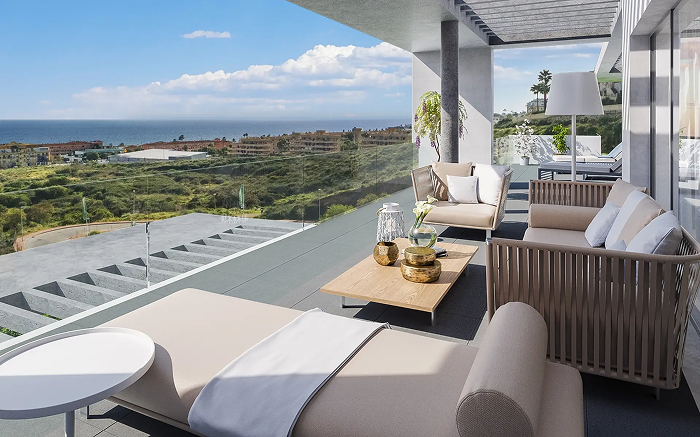

Frontline beach in Marbella commands a typical premium of 30–50% over the equivalent second-line property in the same urbanisation. Before you commit to that premium, you need to understand what “frontline beach Marbella” actually means. Spain’s Ley de Costas (Coastal Law) defines protected zones with practical implications for renovation and rental. The genuine trade-offs between a direct-beach position and one block back are not always obvious. This guide breaks down the terminology, the law, the premium, and the maintenance realities, so you can decide whether the frontline beach premium fits your brief.
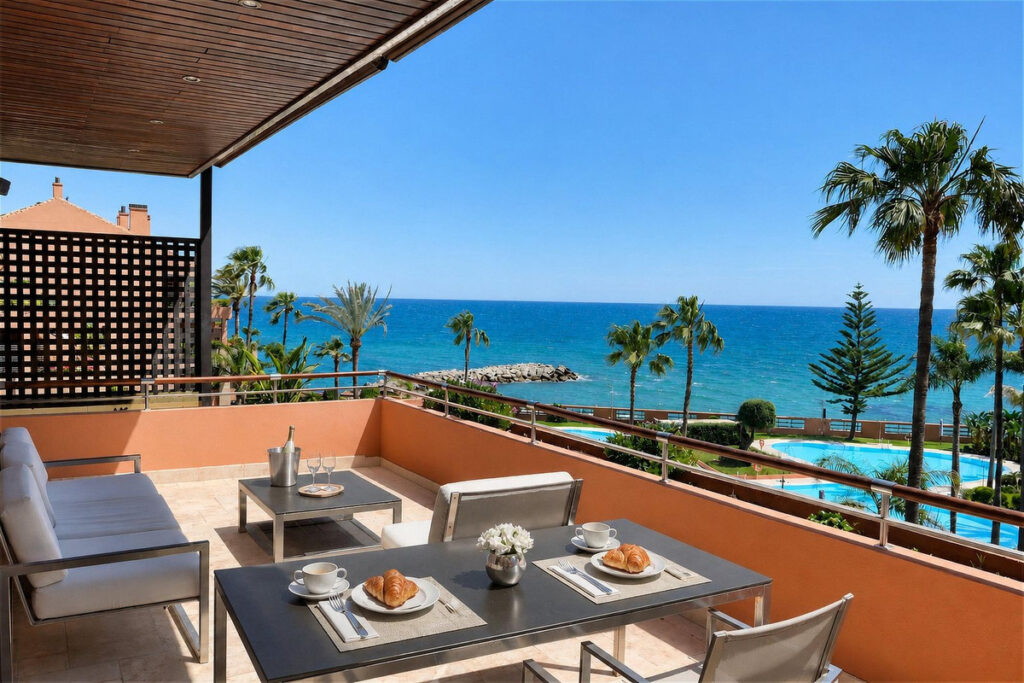
“Frontline beach” is a property-listing term, not a legal one. In strict use it describes a property whose boundary sits directly on the beach promenade or the beach itself, with no road, building, or plot between the home and the sand. From the property’s terrace or garden you have direct visual and physical access to the beach.
In looser use, agents sometimes apply “frontline beach” to properties on the second row (one plot back from the beach) or properties with sea views but no direct boundary. If you are looking for the genuine article, three questions sort it out:
A “yes-no-yes” answer confirms true frontline beach. Anything else is a softer definition.
The distinction matters because the price premium is real. A genuine frontline beach apartment in the Puente Romano complex on the Marbella Golden Mile typically prices at €13,000–€18,000 per square metre. The same specification apartment one block back in a Tier 3 walk-to-beach complex typically prices at €5,000–€8,000 per square metre. The differential reflects scarcity, direct access, and uninterrupted view value.
The same pattern holds in Puerto Banús (Los Granados, Andalucía del Mar, Playas del Duque all frontline), in East Marbella (Los Monteros, Bahía de Marbella), and across the Costa del Sol generally.
Spain’s Ley de Costas (Coastal Law 22/1988, amended in 2013) is the single most important legal framework affecting frontline beach Marbella property. Every buyer of a coastal property needs at minimum a working understanding of how it works.
The law divides the Spanish coastline into three zones, measured inland from the deslinde (the official demarcation line, drawn at the highest reach of normal storm tides):
The public maritime zone (Dominio Público Marítimo-Terrestre). The beach itself, dunes, and tidal zone. This area is state-owned and cannot be privately owned. Existing buildings within this zone (built before the 1988 law) typically operate under concession, with usage rights granted for a maximum of 75 years. After concession expiry, the state can require demolition or repurpose the land.
The protection zone (Zona de Servidumbre de Protección). A band 100 metres inland from the deslinde (reducible to 20 metres in areas classified as urban in December 1989, which covers most established Marbella beach zones). New residential construction is heavily restricted. Refurbishment of existing legal buildings is allowed but with strict conditions: no increase in volume, height, or built surface area.
The right-of-way zone (Zona de Servidumbre de Tránsito). A 6-metre band inland from the deslinde, designated for public pedestrian access and emergency vehicle access. Cannot be built on or closed off.
The influence zone (Zona de Influencia). A 500-metre band inland from the deslinde, where local administrations can impose additional planning restrictions including height limits and architectural controls.
For frontline beach Marbella property, the practical implication is that the first 20–100 metres inland from the high tide line is the protection zone, and any property within it carries restrictions on what can be done with it.

Three practical considerations every frontline beach buyer should verify before committing.
The Spanish notary does not verify Ley de Costas compliance as part of the standard property transaction. This is the buyer’s responsibility. A specialist Spanish property lawyer should request an Informe de Costas (Coastal Report) from the regional Demarcación de Costas before completion, confirming the property’s status, the relevant zone, and any pending revisions.
The frontline beach premium varies by area, property type, and market segment. Typical ranges in 2026:
Apartments:
Villas:
The premium has been remarkably stable through market cycles. Frontline beach in Marbella commands the same approximate premium today that it did in 2015, with the underlying price levels having risen for both frontline and second-line. The premium reflects scarcity that is structural and not market-cyclical: the Ley de Costas means new frontline supply cannot meaningfully increase, while demand for direct-beach access continues to grow.
The view is the obvious benefit. The trade-offs are less often discussed and matter substantially for full-year usability and resale value.
Salt-air maintenance. Frontline beach properties are exposed to substantially higher salt air than properties even 50 metres inland. The practical impact: shorter lifespan on metal fittings (window frames, balcony railings, garden furniture, electronic equipment), faster paint degradation on exterior walls, and accelerated corrosion on air conditioning units, pool equipment, and structural metal. Annual maintenance budgets for frontline beach property typically run 30–50% higher than equivalent second-line property.
Storm exposure. The Costa del Sol experiences periodic strong storms, with occasional eastern-Mediterranean fronts driving substantial wave action onto exposed beaches. Frontline properties absorb most of the impact: damaged terraces, salt-spray inside the property, sand deposition in gardens, and occasional flooding of ground-floor units. Premium frontline complexes have engineering measures in place (raised foundations, sea walls, drainage systems), but the exposure is real.
Rental licensing constraints. Short-term tourist rental in Spain requires a regional tourist licence (Licencia de Vivienda con Fines Turísticos). For frontline beach properties, additional regulations sometimes apply, including local Marbella ordinances limiting the number of tourist licences issued in specific complexes. Investors planning to use frontline beach Marbella property for short-term rental should verify licensing availability before purchase.
Beach access does not equal beach ownership. All Spanish beaches are public under the constitution and the Ley de Costas. Frontline property gives you the closest access, but the beach in front of your property is open to public use. The Servidumbre de Tránsito (6-metre right-of-way) typically runs along the back of the beach itself, ensuring pedestrian access along the full Spanish coastline. Owning frontline beach does not give you a private beach, a private path to the beach, or any right to restrict public use of the sand or sea.
Renovation restrictions. Properties within the 20–100 metre protection zone face significant restrictions on what can be modified. Volume cannot be increased. Height cannot be increased. The built footprint cannot be expanded. External architectural changes require approval. Buyers planning substantial renovation should verify what is permitted before committing.
Noise and crowd patterns. Frontline beach property absorbs the noise of the beach itself, particularly in peak summer. Beach clubs, beach bars (chiringuitos), and public access patterns concentrate at the beach front. For buyers prioritising quiet, this can be a meaningful trade-off; for buyers prioritising the beach lifestyle, it is part of the appeal.
Three buyer profiles where the frontline beach premium typically pays off:
Peak-summer lifestyle buyers. If you use the property primarily May to September and the beach is central to that usage, the direct access genuinely changes daily life. The time saved by not crossing a road and walking down a path materially increases beach time across a summer stay. The premium is justified.
Rental investors with the right licensing. Frontline beach Marbella property commands meaningful premiums in short-term rental rates, particularly during peak summer weeks. For investors with the appropriate tourist licence and a property in a complex that permits short-term rental, the yield differential can justify the price premium over a 7–10 year hold.
Ultra-prime lifestyle and prestige buyers. At the ultra-prime end, frontline scarcity means the available stock is genuinely limited, and the prestige of a true frontline beach address holds value reliably through market cycles. For buyers in this segment, the premium reflects what they are actually paying for.
Two profiles where the second-line position is typically the better fit:
Full-year residents. The salt-air maintenance burden, the storm exposure, the noise and crowd patterns in peak summer, and the renovation restrictions all weigh more heavily on full-year residents than peak-summer users. A second-line position 50–200 metres inland typically delivers most of the lifestyle benefit (5-minute walk to the beach, sea views from upper floors) with substantially lower running costs and fewer restrictions.
Buyers prioritising renovation potential. Second-line properties are typically not within the Ley de Costas protection zone (or are within the more permissive sections of it), making substantial renovation and expansion projects viable. Buyers planning to acquire an older property and rebuild to a higher specification typically find second-line offers more flexibility than frontline.
Crinoa works across both frontline and second-line beach Marbella inventory, from the prime beachfront complexes (Puente Romano, Los Granados, Playas del Duque, Andalucía del Mar) through second-line apartments and villas in the same urbanisations. If you are weighing frontline against second-line and want a tailored shortlist that compares both sides of the trade-off, including the Ley de Costas implications for each property, we can pull one together.
For the wider Marbella context, see our best Marbella neighbourhoods comparison guide, our Marbella property market overview.




Are you considering choosing us to sell your property? Or do you want to schedule a viewing? Please complete the contact form below, and we’ll respond as soon as we can.
Frontline beach in Marbella means a property whose boundary sits directly on the beach or the public maritime promenade, with no road, building, or plot between the property and the sand. The property’s terrace or garden gives direct visual and physical access to the beach. Some agents apply the term to second-line or partial-view properties, so always confirm whether the boundary genuinely shares a line with the beach.
Frontline beach property in Marbella typically commands a premium of 30–50% over the equivalent second-line property in the same urbanisation. Apartment premiums typically run 40–50% in Puerto Banús and 40–60% on the Golden Mile. Villa premiums are higher (50–100%-plus) because frontline villa plots are genuinely scarce and the Ley de Costas prevents new frontline construction from increasing supply.
Frontline beach property in Marbella typically commands a premium of 30–50% over the equivalent second-line property in the same urbanisation. Apartment premiums typically run 40–50% in Puerto Banús and 40–60% on the Golden Mile. Villa premiums are higher (50–100%-plus) because frontline villa plots are genuinely scarce and the Ley de Costas prevents new frontline construction from increasing supply.
The Ley de Costas is Spain’s Coastal Law (Law 22/1988, amended in 2013). It defines the legal boundary between private property and state-owned coastline, with a 100-metre protection zone inland from the high tide line (reducible to 20 metres in pre-1989 urban areas) where new construction is restricted and refurbishment of existing buildings carries strict conditions. Every frontline beach buyer should verify the property’s Ley de Costas status before purchase.
No. Under the Ley de Costas, the beach itself, the tidal zone, and the dunes are state-owned and cannot be privately owned. Frontline beach property owners own the land up to the deslinde (demarcation line) but not the beach itself. Existing buildings within the public maritime zone (built before 1988) typically operate under 75-year concessions rather than freehold ownership.
It depends on your usage pattern. For peak-summer lifestyle buyers and short-term rental investors with appropriate licensing, the premium typically pays off. For full-year residents, the higher maintenance costs (30–50% above second-line), storm exposure, and renovation restrictions often make second-line the better balance. Walking through both options before committing usually clarifies the right fit.
For buyers researching independent market data, INE (Instituto Nacional de Estadística) publishes the official Spanish property transaction statistics, providing a verified overview of price and volume trends across Marbella, the Costa del Sol, and the wider Provincia de Málaga.
Approximately 80% of Marbella property buyers choose apartments over villas. This is despite...Read More
Beachfront property in Puerto Banús is the most concentrated cluster of frontline apartment...Read More
La Zagaleta property for sale spans 900 hectares of gated Benahavís hillside, with...Read More
International schools in Marbella cluster around three main catchment areas: Nueva Andalucía (Aloha...Read More
Frontline beach in Marbella commands a typical premium of 30–50% over the equivalent...Read More
Puerto Banús in Marbella opened in May 1970 as a luxury marina built...Read More
We use cookies to improve your experience on our site. By using our site, you consent to cookies.
Manage your cookie preferences below:
Essential cookies enable basic functions and are necessary for the proper function of the website.
Google reCAPTCHA helps protect websites from spam and abuse by verifying user interactions through challenges.
Google Tag Manager simplifies the management of marketing tags on your website without code changes.
Statistics cookies collect information anonymously. This information helps us understand how visitors use our website.
Google Analytics is a powerful tool that tracks and analyzes website traffic for informed marketing decisions.
Service URL: policies.google.com (opens in a new window)
You can find more information in our Cookie Policy and Privacy Policy.
This feature is under construction and will be live shortly.